
Greene Projected Versus Actual Release
A projected release date is the correctional authority’s current calculation. It is not a promise and is not the same as a release record. Virginia Department of Corrections procedures use that term, but any public locator result must be read by the exact label shown at the time. VADOC also uses several other date concepts, including good-time release, mandatory parole release, discretionary parole eligibility, and actual release. Those labels describe different points.
Actual release requires execution. VADOC staff review warrants, criminal detainers, civil holds, court orders, uncalculated sentences, classification, and discipline that may affect credit. They verify release papers and the discharge date. Central Virginia Regional Jail likewise must positively identify the person, confirm lawful authority, and check other jurisdictions for holds. The end of one sentence can therefore lead to a transfer rather than entry into the community.
Pretrial custody is different. Without a sentence, there is no term to reduce through earned credit. A Greene defendant may leave after bond, dismissal, or another order, but the jail still must process that authority and clear holds. Court action is necessary evidence, not proof of the physical exit time.
Find a Greene Release Date
Start with the custodian. A Greene arrest often produces records at the Sheriff, CVRJ in Orange, and a Greene court. A state-responsible sentence belongs in VADOC systems even if the person once stayed at CVRJ. The VADOC Inmate & Supervisee Locator covers people under active custody or supervision, updates daily, and accepts a name or seven-digit DOC ID.
- Identify whether the person is pretrial, locally sentenced, or serving a VADOC-responsible term.
- For VADOC, enter at least the first three letters of the first name and the full last name, or use the DOC ID. Optional filters include location, race, gender, and age range.
- Read the date and status labels exactly as displayed. Do not rename every date “projected.”
- For a CVRJ sentence, call the jail and request the official time-computation or release record while checking the controlling Greene court orders.
- For a fully discharged person missing from the active locator, use VADOC’s inactive-offender records route.
The Greene County released-inmate lookup explains how to combine the custodian event, court disposition, and any next custody. One public docket entry is not enough when there are several cases, concurrent or consecutive terms, or a detainer.
If the active VADOC locator returns no result for a person believed to be fully discharged, use the agency’s Request for Records for an Inactive Offender. Ask for the verified discharge date, release type, final custody destination, and correctional-status record. Releasable release orders or notification letters can provide stronger evidence than a search miss. VADOC accepts records requests through several channels and prefers a clear written scope.
The official VADOC time-computation page shows the state’s GCA and ESC terms and explains who calculates a sentence.
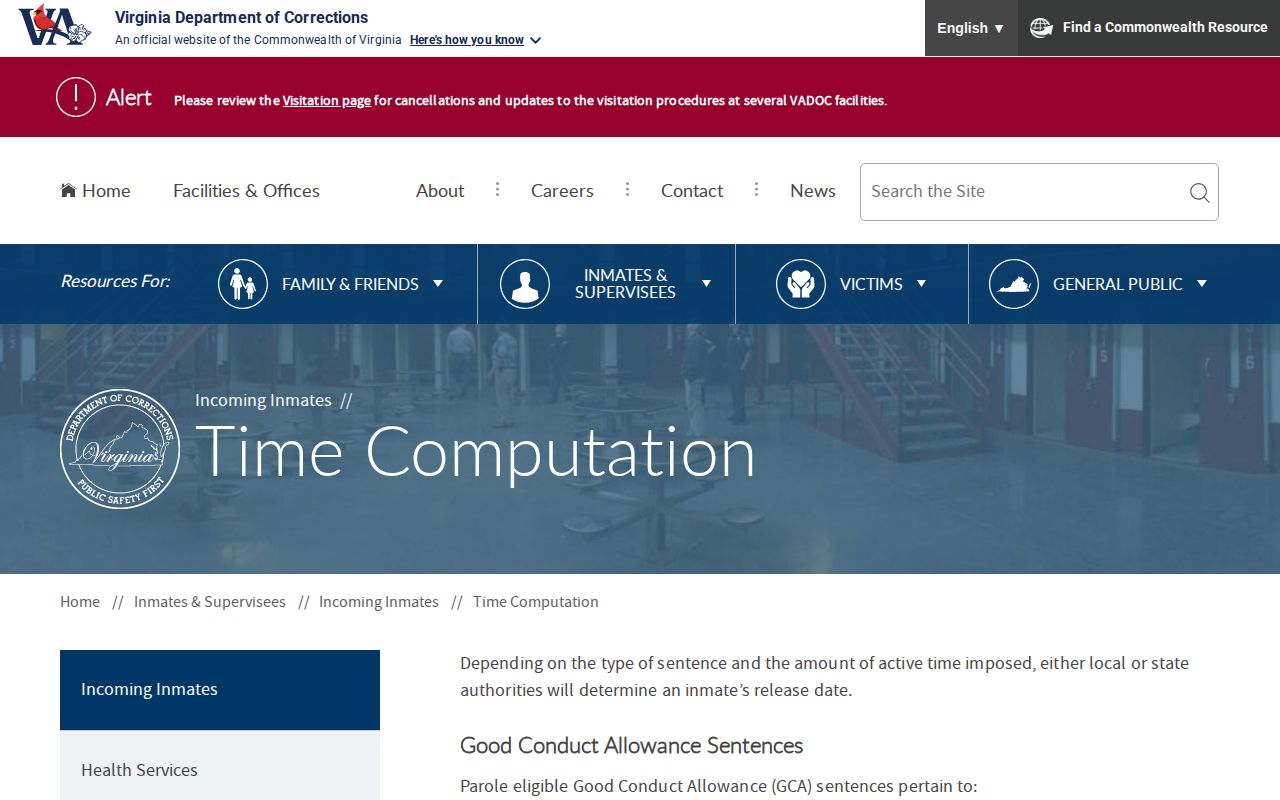
This source helps identify the calculation framework, but it is not a public calculator for a named Greene County person.
Virginia Credits Shape Greene Dates
Virginia generally ended discretionary parole for felony offenses committed on or after January 1, 1995, subject to statutory exceptions. VADOC explains that applicable people serve at least 85 percent of a sentence. That phrase reflects the maximum 4.5 earned days per 30 served for the serious offenses listed in Virginia Code § 53.1-202.3. It is not a rule that can be applied to every Greene County sentence.
Under the post-1994 earned-sentence-credit framework, one credit deducts one day. Rates depend on the offense and earning level. Enumerated serious offenses are capped at 4.5 days per 30 served. Other eligible offenses may fall into Level I at 15 days, Level II at 7.5, Level III at 3.5, or Level IV at zero per 30 days served. Conduct, program participation, classification, and exclusions matter. Mandatory minimum time is not shortened in the same way.
The official Virginia earned-credit article sets out the legal structure behind those rates.
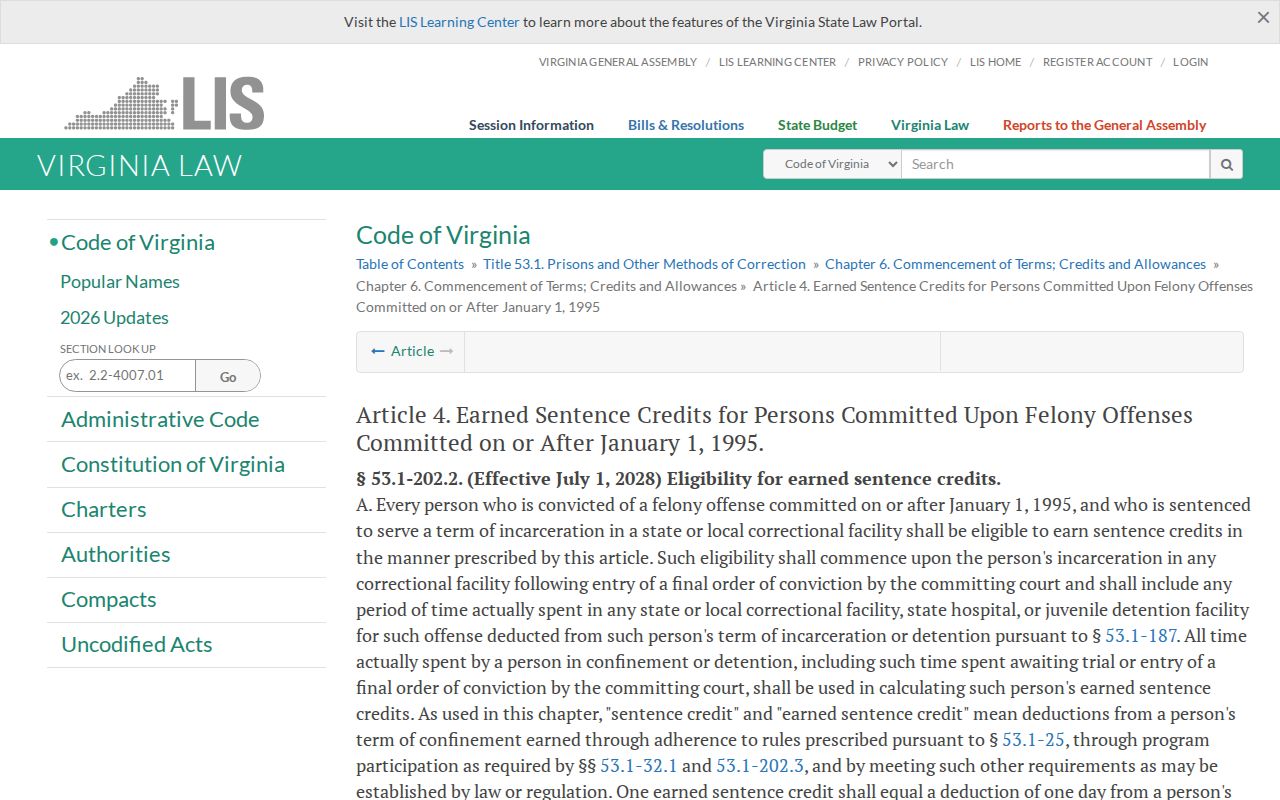
The statutory page confirms why offense class and earning level must be known before a correctional authority can state a projected release date.
Older structures can use good conduct allowance, or GCA. Post-1994 felony structures use earned sentence credits, or ESC. VADOC describes ESC-1 as a range up to 4.5 days per 30 and ESC-2 as potentially up to 15. Prior jail time, imposed sentence, earning class, discipline, and later orders all feed the official calculation.
Note: The 85-percent shorthand applies to a defined set of sentences and cannot safely predict one person’s Greene County release date.
Why Greene Release Dates Change
A date moves when the legal term or the credits applied to it change. Even if the sentence calculation stays the same, another lawful hold can change the person’s destination. These factors should be checked with the authority that owns the computation.
| Factor | Possible effect |
|---|---|
| Earned-credit level | Offense rules and classification produce different rates and good-time dates. |
| Discipline or credit action | Expected credit may be lost, restored, or recalculated under governing procedure. |
| Prior jail time | Certified presentence confinement changes the time left to serve. |
| Court order | A new, corrected, concurrent, or consecutive term changes the sentence components. |
| Warrant, detainer, or hold | The sentence may end while custody continues under another authority. |
| Parole decision | Eligibility, a Board grant, and actual physical release are separate stages. |
| Operations or weather | VADOC says discharge or parole occurs by 11:59 p.m. on the date, weather permitting. |
A parole grant is not proof that the person has left. The Virginia Parole Board decision must be followed by the required release process. Likewise, a projected date may arrive before staff find a warrant or unresolved sentence. The actual event and its destination remain the final evidence.
Virginia parole eligibility adds another date that can be confused with release. Discretionary parole was generally abolished for felony offenses committed on or after January 1, 1995, with exceptions. Older eligible terms use statutory fractions and caps, and special offense rules may control. Eligibility is only the point at which review may occur. A Board decision, any required notice period, and VADOC’s executed release are later steps.
Confirm Greene Actual Release Dates
For CVRJ custody, Virginia Jail VINE can supply an event notice for one named person. Call the jail at 540-672-3222 and ask whether processing is complete, which authority ended the hold, and whether another custodian received the person. When durable proof is needed, request the executed release entry from the CVRJ Custodian of Records and compare it with the Greene court order.
For state custody, VADOC notifications distinguish “Advanced release,” usually an anticipated event, from “Release date,” when VADOC custody ends. A date-change notice may fall between them. State custody notifications use NAAVI, not the original Jail VINE registration. The Greene County VINE inmate check explains this handoff and the need to register again after a transfer.
Release papers may include an Order of Release, Conditions of Probation, Conditions of Parole, signatures, dates, and a notification-of-release letter. They show what VADOC authorized. Still check for a transfer notation because physical release from VADOC can end at another custodian rather than in the community.
Note: Court disposition proves judicial action, while the custodian record proves the executed movement and its recorded destination.
Greene Jail Credit Policy
Local jail calculation has its own Greene County wrinkle. Under Virginia Code § 53.1-116, each jailer must keep commitment and person records and maintain a written policy on earned credit and revocation. A person serving 12 months or less for a misdemeanor or combined misdemeanors can earn one day of good-conduct credit for each day served without a jail-rule violation, unless a mandatory minimum controls. Qualifying pre-conviction jail days can count.
A jail may also award five additional days per 30 for work assignments, classes, or local workforce programs when those options exist in policy. That part is not automatic. Rule violations can add deducted time back. Post-1994 felony credit in a local jail cannot exceed the limits in the statewide earned-credit article.
The responsible authority depends on the sentence category and active time. A locally sentenced person at CVRJ may have local computation, while a state-responsible term belongs to VADOC even if the person temporarily remains in a regional jail. Ask which authority calculated the date and which court orders were included. Also ask whether the date is a good-time date, mandatory parole date, discretionary eligibility date, or another form of release date.
The official local-jail statute shows the required written-policy framework for a Greene sentence held at CVRJ.
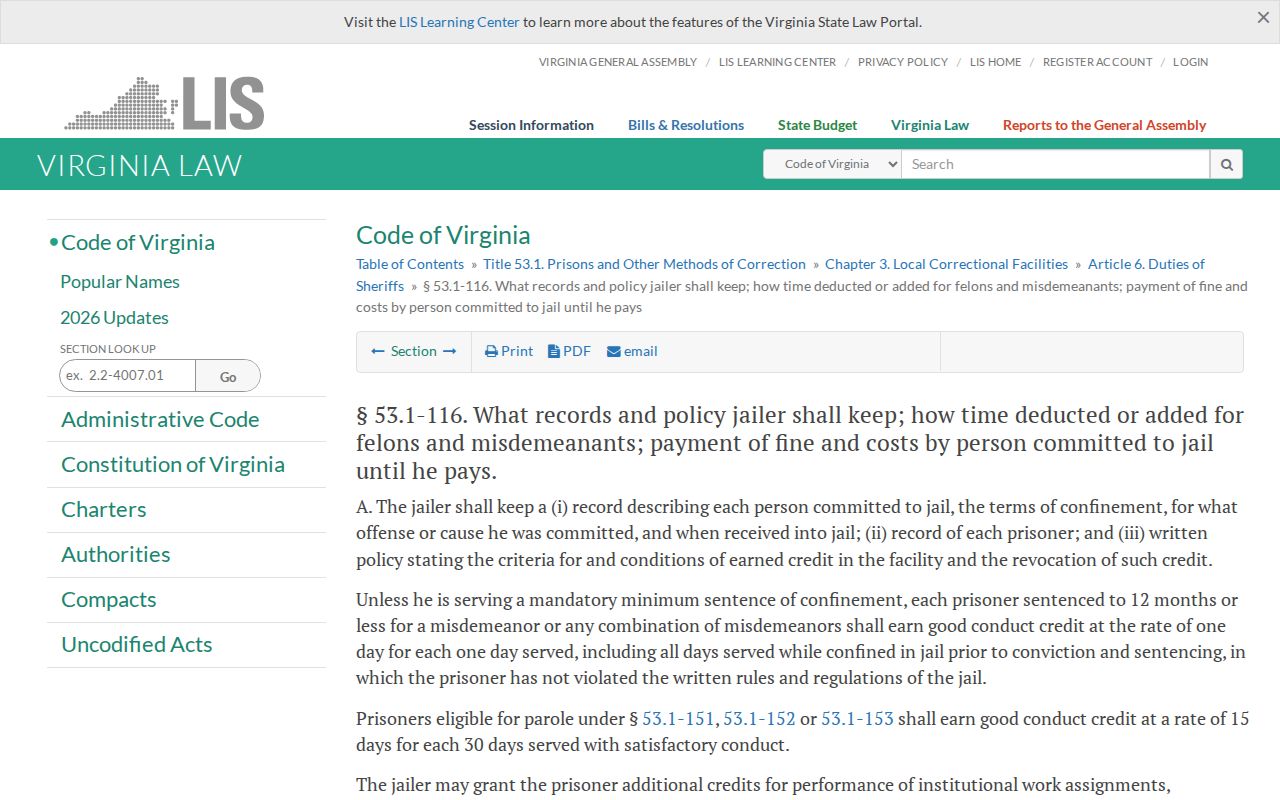
The correct next step is to ask CVRJ for its current policy and the person’s official computation, not to calculate the date from sentence length alone.
Do Greene Weekend Dates Move
No statewide Virginia rule found in the Greene research automatically shifts a weekend or holiday release to Friday. Virginia Code § 53.1-131.1 allows a court in specified cases to order short active terms served on weekends or other nonconsecutive days. That is a sentencing arrangement, not a general release-date adjustment.
This distinction is the page’s required Greene-specific computation angle. Ask CVRJ how an individual order is being administered and whether final processing is complete. Do not infer a revised date from the calendar. The jail’s written credit policy, the court order, and the official time record control.
Weekend service can also be revoked when conditions are not met, which can change how the active term is served. That possibility reinforces the same rule: a calendar pattern is not a sentence calculator. Use the signed order and the custodian’s current computation for the named person.